
Blog Posts•General
How Atlassian Ascend Redefines Enterprise Cloud Security and Governance
Atlassian Data Center ends support in March 2029. Atlassian Ascend marks a strategic shift to…
Mar 4, 2026
Migrating from Atlassian Data Center to Cloud changes your risk landscape: Atlassian handles infrastructure, but identity, audit, data residency, and third-party apps remain your responsibility. This guide translates technical controls into business-risk language, helping executives understand the compliance, operational, and regulatory impacts. Learn how to align Atlassian Cloud security with boardroom priorities and enterprise risk management.
For enterprise leaders, especially in highly regulated sectors like finance, security isn’t about technical controls. It’s about business risk, regulatory defensibility, and strategic resilience. Yet when organizations assess their Atlassian estate, particularly those still on Data Center, the cloud conversation often gets tangled in jargon and implementation details rather than executive risk outcomes.
This piece reframes Atlassian Cloud security as a business conversation: one that CEOs, boards, and executive teams can lead with confidence.
Traditional Atlassian Data Center environments burden internal teams with infrastructure security, patching, and compliance evidence. Risks here show up as:
In finance environments, where audit cycles and controls are intensively scrutinized, such operational risk translates into compliance risk, financial penalties, and brand erosion.
Atlassian Cloud shifts a large part of infrastructure security into Atlassian’s shared responsibility model, but that does not eliminate responsibility on the enterprise side. Rather, it consolidates risk, making it more visible, measurable, and auditable… if you manage it correctly.
Instead of asking “Is the cloud secure?” leaders should ask:
“How does Atlassian Cloud change our enterprise’s risk exposure compared to Data Center?”
In most on-premises deployments, audit evidence lives in multiple tools, exports, screenshots, and know-how. Not surprisingly, this leads to:
This is particularly acute in finance, where SOX, PCI DSS, and internal controls demand traceable user activities, access logs, and evidence of controls.
Our recent article on Top Security Mistakes in Atlassian Cloud Migration highlights that many enterprises overlook audit logging and encryption in cloud setups, often the very controls auditors require proof for.
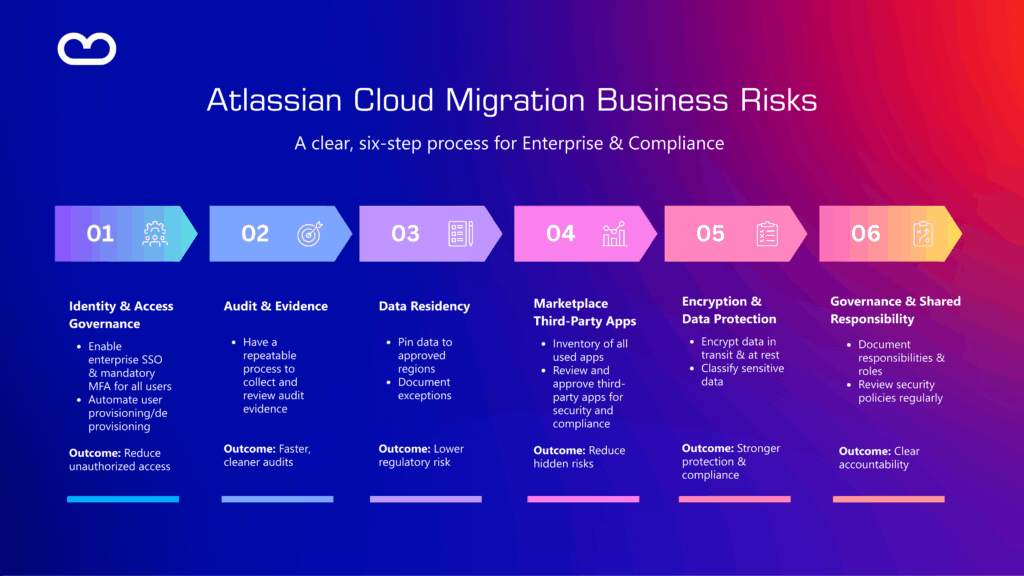
Cloud can make audit evidence easier, but only if you build governance habits. Tools like Atlassian Guard can standardize and centralize security logs, helping move audit evidence from unreliable manual artifacts to repeatable, verifiable sources.
A cloud environment is not just about where data lives; it’s about who has legal jurisdiction over it and how it is governed.
In this article, Data Residency: Digital Trust in Atlassian Cloud, we clearly show that modern enterprises can no longer treat data residency as a box-ticking exercise. For finance leaders, the stakes are further elevated:
Data residency is strategic, not technical. However, one under-appreciated risk comes from Marketplace app data. While Atlassian can pin core product data to a region, third-party apps often store data outside those boundaries, potentially exposing regulated data to non-compliant jurisdictions. This is a compliance risk that finance teams cannot ignore when crafting a cloud-migration risk narrative.
Boards and finance executives are rarely interested in control mechanisms such as SAML or ACLs. They care about:
Translate security controls into risk outcomes, for example:
Framing security around impact and consequence is what earns traction in the boardroom.
Enterprise financial institutions face a unique intersection of risks:
Cloud migration offers a chance to strengthen your control environment, but planning must align with financial risk priorities:
This financial lens turns cloud security from a technical procurement decision into a risk-mitigation strategy with measurable KPIs.
For enterprises, especially in finance, Atlassian Cloud security should be reframed away from technology checklists and toward enterprise risk management. Tools like Atlassian Guard, data residency controls, and a disciplined approach to third-party apps are not just technical enablers; they are narrative pillars in your organization’s risk story.
Managing cloud securely is about visibility, evidence, accountability, and alignment with business outcomes. When you translate technical controls into business risk language, you empower leadership to make confident, informed decisions on your cloud transformation journey.